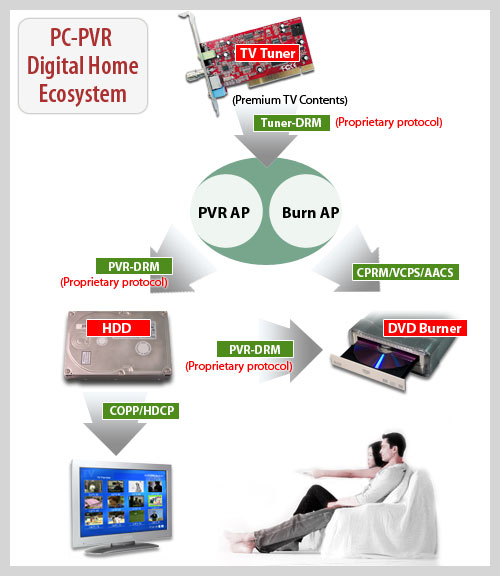
From the fallout of the Napster and music companies courtroom battles to the current illegal pirating of DVD movies, the issue of content protection is brewing at the center of a digital maelstrom refusing to cease or desist. Until a satisfactory conclusion is reached for both the content provider (e.g. movie studios) and the consumer, each side will suffer the consequences. The Digital Rights Management (DRM), at the center of digital piracy concerns, is a complex issue. The content providers and producers expect multiple levels of security—transmission (e.g. TV signals) and playback, during storage (e.g. in your hard drive), and at the point of copying (e.g. burning to a disc)—while the CE/PC industries worry over the multitude of formats, multifaceted standards and chaotic protocol configurations. To make it easier to understand, just imagine that every level of security has a corresponding hardware device governing the passage of information, like a toll booth that grants cars (i.e. the flow of information) passage only if fees are paid (i.e. content protection standards are adhered to). For example, tuner cards, recording and burning software, hard drives, and burners could all regulate how protected/unprotected content is shared. If content protection is not abided by, similar to a driver who is stuck for change at a toll booth, content will not be allowed to be played, copied, nor shared.
Digital Transmission Content Protection (DTCP) and CyberLink PowerCinemaWithin digital home networks, the transmission between client and server devices has to be protected (i.e. DTCP). Digital Transmission Content Protection over Internet Protocol (DTCP-IP), specified for protection of copyrighted content transferred over digital interfaces in home networks, is currently the standard protocol. Users will be able to transmit and share content over secured devices within a digital home network, but not to third-parties or over the Internet. The world's authoritative digital home software, CyberLink PowerCinema, ensures content protection by guaranteeing that Digital Rights Management (DRM) are abided by. By collaborating with Intel in implementing DTCP-IP, PowerCinema enables consumers to share protected content between digital home products over wired and wireless networks while protecting the interests of premium content providers. Content Protection of Recordable Media (CPRM) and CyberLink PowerDVD
In other words, recorded content may only be played on the device you recorded it on, which is ensured by adding a Media Identifier and a Media Key Block to the media content. Only CPRM-enabled devices or software applications (e.g. CyberLink PowerDVD) can read the identifier and key block, decrypting the data for playback after content has been authenticated. Users are prevented from playing protected content using hardware or software that is not CPRM-enabled. PowerDVD, Japan, and CPRM
Other Protection Systems
Developed by Intel Corporation to protect digital entertainment content, High-bandwidth Digital Content Protection (HDCP) is a robust, cost-effective and transparent method/specification for transmitting and receiving digital entertainment content to DVI/HDMI-compliant (Digital Video Interface / High-definition Multimedia Interface) digital displays. Refer to the DVI/HDMI for more information. The reason why HDCP specification goes hand-in-hand with DVI/HDMI is an easy one—content providers are protecting their copyrights in all digital-to-digital transmissions within the home network. Content Protection from the Content ItselfThe content protection onus does not fall squarely on hardware vendors. Content providers may also enable their content to protect itself in the form of: Copy Control Information (CCI): located in packet headers and embedded in the content stream itself, it specifies the number of times the content can be copied (e.g. copy freely, once, no more, or never) Authentication and Key Exchange (AKE): occurs between the source and sink of each link and comes in either full authentication mode (a signed exchange of device certificates) or restricted authentication mode (supports copy once and copy no more content only). System Renewability: all DTCP sink devices contain certificates that may be revoked, which are clearly defined in the license agreement.
After passing the UPnP MediaServer and MediaRenderer testing conducted by the UPnP™ Implementers Corporation (UIC), CyberLink PowerCinema 4 received the UPnP™ logo that gives users the assurance of total interoperability support between UPnP™ devices and allows the sharing of data between appliances anywhere within the digital home. PowerCinema is listed as a compatible product on the UIC Certification site at http://www.upnp-ic.org/certification/default.asp#devices.
|
||||||||||||||||||||||||








Want the newest updates?
Get notified of the latest promotions, feature updates, tutorials, events & more!
Allow
No Thanks