
In the competitive world of online dating, a great profile photo is everything. One of the world's most recognized dating apps — with tens of million active users every month — knows this better than anyone. To help users put their best face forward, the app built an AI-powered photo selection feature on top of FaceMe SDK, using it for on-device face matching between a reference selfie and the user's camera roll — all running natively on iOS and Android. The result is a seamless, privacy-first experience that is redefining how people present themselves in the digital dating landscape.
For users, selecting the right profile photo is a surprisingly daunting task. A survey of dating-app users highlights the scale of this problem [1]: 85% of singles believe their dating profile is key to representing their real selves, yet 52% struggle to pick the right photos, 68% say they'd welcome AI help making better choices, and singles aged 18-24 spend an average of 33 minutes picking their profile photos.
Beyond user frustration, the stakes are high: data shows that users who include multiple clear face photos in their profile significantly increase match likelihood. Yet without the right tools, most users have no reliable way of knowing which photos will perform best.
A critical requirement: the solution had to run entirely on-device—not cloud-based—to protect privacy. Any solution would need to be compact, fast, and accurate enough to process thousands of photos directly on users' smartphones, without compromising performance or experience.
To address this, the dating app introduced the photo selection feature, powered by the FaceMe facial recognition SDK. The entire process runs on the user's device - no photos are sent to external servers - keeping the process private by design.
Based on the app's technical write-up [2]: the user takes a quick selfie as a biometric reference, and FaceMe's facial recognition engine scans the user's photo library to identify which photos contain the same person. These are then scored by a separate machine-learning model developed by the app for predicted engagement and passed through a content-moderation check, and the resulting shortlist is presented to the user, who makes the final call on what goes into their profile.
This layered, on-device pipeline - face detection and matching, quality scoring, and content review - works together to deliver fast, accurate recommendations without biometric data ever leaving the user's phone.
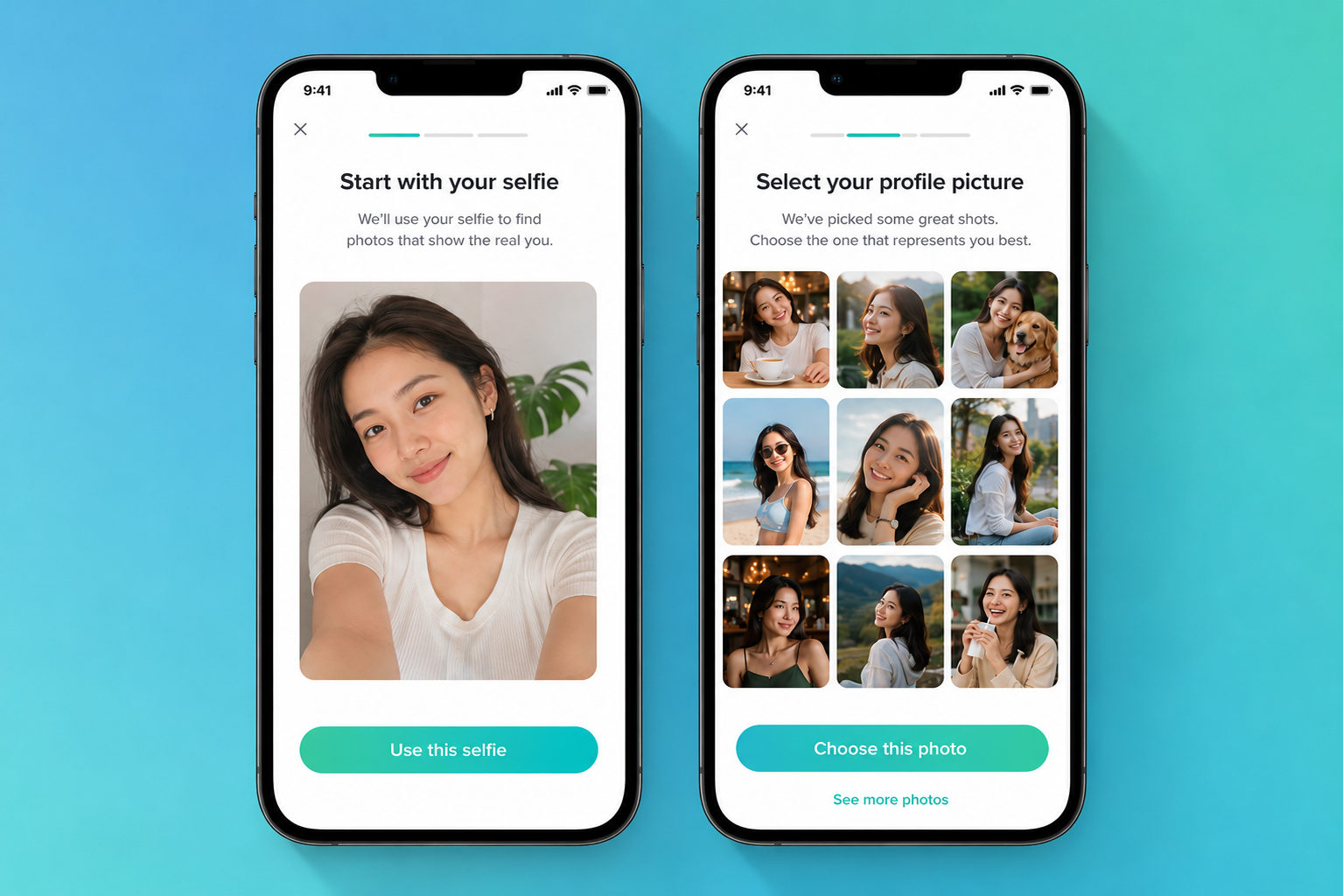
After extensive testing, the app moved this feature from experimentation to a full global rollout, available for all users. [2] It's a real-world example of what the on-device FaceMe facial recognition SDK can support at consumer scale: fast, private, and accurate enough to run invisibly in the background of a feature used by tens of millions of people.
 Book a Demo