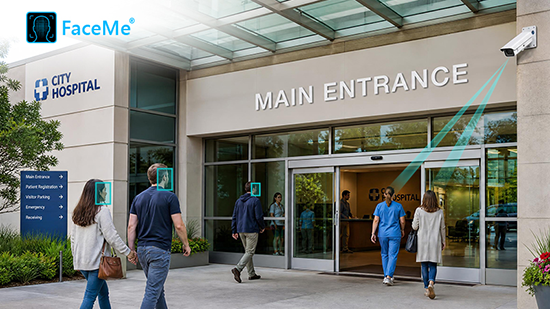
A large New Jersey hospital needed to strengthen security at its entrances while preserving an open, welcoming environment for patients and visitors.
FaceMe® Security adds real-time facial recognition and blocklist detection to the hospital's existing surveillance infrastructure, alerting security personnel through the video management system (VMS) they already use when someone on an authorized blocklist enters a monitored location.
This enables the hospital's security team to identify potential risks earlier and respond before an incident escalates, all without replacing its existing cameras.
Hospitals present a unique security challenge: they must remain accessible around the clock while protecting patients, employees, and visitors from workplace violence, unauthorized access, and other threats.
Many security incidents begin at entrances where a known individual may enter the facility before staff can recognize the risk. This could include someone with a documented history of violence, an unauthorized visitor, or a former employee subject to access restrictions.
The risks are significant. Healthcare employees experience nearly five times as many workplace violence injuries as workers in other industries.¹ Hospitals also report approximately 22 assaults per 100 beds annually, up from 17.7 the previous year, with 93% of assaults involving nonemployees.²
At the same time, security teams are being asked to do more with limited resources, and the hospital needed a solution that could:
• Monitor priority entrances using its existing surveillance cameras.
• Identify authorized blocklist matches as individuals arrive.
• Alert security personnel immediately through the existing VMS.
• Help a limited security staff monitor multiple entrances more effectively.
• Strengthen security without slowing access to care or creating unnecessary friction for patients and visitors.
Avoid the cost and disruption of replacing cameras with new AI-enabled models, which can cost approximately $2,900 to $3,400 per unit.³
The hospital deployed FaceMe Security's blocklist detection capabilities across selected entrance cameras and integrated the solution with its existing VMS.
As people enter a monitored area, FaceMe detects visible faces and compares them in real time against the hospital's authorized blocklist, sending an alert through the VMS alongside the live video when it finds a potential match.
Security personnel can then review the alert and respond according to the hospital's established procedures.
The solution runs on servers within the hospital's own environment, so facial images, templates, and related data never transmitted to CyberLink or an external cloud service.
FaceMe Security does not replace security personnel or make response decisions for them. It gives them an additional layer of real-time awareness.
That capability is increasingly important as hospitals face persistent staffing challenges. Hospital security staffing has declined to 9.5 full-time employees per 100 beds, compared with 10.7 the previous year, while 65% of hospitals report difficulty filling security positions.²
By continuously monitoring designated entrances, FaceMe Security can help a stretched team:
• Detect potential concerns sooner.
• Monitor more entry points simultaneously.
• Reduce dependence on an employee recognizing someone from memory.
• Prioritize alerts that require immediate review.
• Coordinate a faster and more informed response.
Traditional video surveillance is often used to investigate incidents after they occur; FaceMe Security transforms that infrastructure into a proactive detection system that lets personnel intervene earlier.
Research has associated monitored areas with a 13% overall reduction in crime and reductions of up to 37% in high-traffic environments such as parking facilities.⁵ Real-time blocklist detection builds on this foundation by converting passive camera footage into actionable alerts.
Facial recognition in healthcare environments requires clear policies, appropriate oversight, and transparency. FaceMe Security is designed to operate within the hospital's existing security and privacy framework, not outside it.
The hospital remains responsible for determining:
• Who may be added to a blocklist.
• The documented reason for each person's inclusion.
• How long blocklist records and alerts are retained.
• Which employees may access facial data and alerts.
• How potential matches are reviewed and acted upon.
• When records should be updated or deleted.
Role-based permissions restrict access to authorized personnel, activity logs support internal review, and the hospital can set its own match thresholds, retention schedules, escalation procedures, and verification requirements.
Public acceptance depends heavily on how surveillance technology is deployed. Although 58% of U.S. adults report being more comfortable with video surveillance than they were five years ago, particularly when it is used for safety and accompanied by clear signage, 66% remain concerned about AI accuracy and misuse.⁴ These findings reinforce the importance of transparency, human oversight, and well-defined governance.
Because FaceMe Security can be deployed on premises, the hospital can keep processing and storage within its controlled IT environment, supporting its broader efforts to safeguard sensitive information.
FaceMe Security gives the hospital a practical, cost-effective way to strengthen entrance security using the cameras, servers, and VMS infrastructure it already operates.
Instead of relying on personnel alone or reviewing video after the fact, the security team now gets real-time alerts when a blocklist match appears at a monitored entrance.
The result is a more proactive security posture:
• Known risks can be identified earlier.
• Security personnel can assess and respond faster.
• Existing cameras become more valuable.
• Sensitive facial data can remain within the hospital's environment.
• Patients and legitimate visitors can continue entering without additional checkpoints or delays.
For hospitals balancing open access, limited security resources, and a growing risk of workplace violence, FaceMe Security provides the intelligence needed to identify potential threats at the door, rather than after an incident occurs.
¹ U.S. Bureau of Labor Statistics, Workplace Violence in Healthcare, 2021-2022 (2024).
² IAHSS Foundation, 2023 Healthcare Crime Survey (November 2023).
³ Monarch Connected Security, Commercial Security Camera Costs (2026).
⁴ Axis Communications, Public Perception of Video Surveillance (2026).
⁵ Piza et al., CCTV Surveillance for Crime Prevention, Criminology & Public Policy (2019).
 Book a Demo