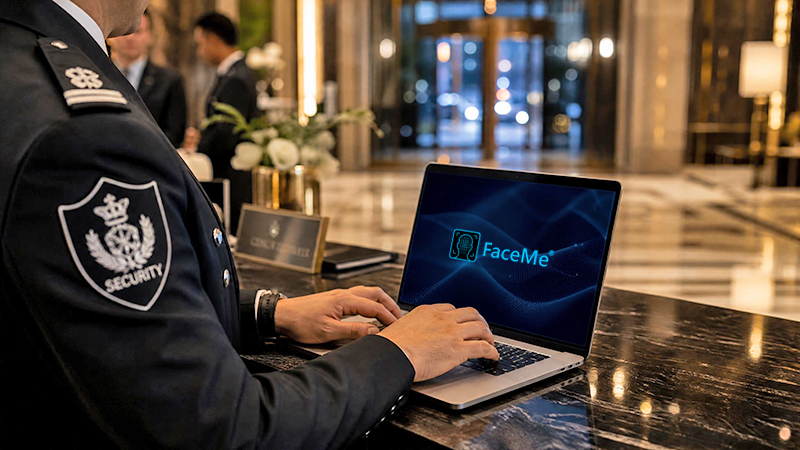
A U.S. mobile security team protecting executives, government officials, and other high-value individuals needed to know immediately when an unfamiliar person approached a secured location. FaceMe® Security gives the team portable, fully offline facial recognition that quickly verifies authorized personnel while flagging unknown individuals for further review.
FaceMe Security runs on a standard laptop that integrates with the team's existing AXIS Camera Station, letting the team add facial verification to a temporary post in minutes, without new infrastructure or a network connection.
Protective security has become a more urgent priority across both the private and public sectors, from corporate boards to government agencies protecting officials and dignitaries. Reported attacks against corporate executives alone doubled in 2025, with 95 incidents in the first ten months and roughly a third resulting in physical injury or death.1 Government protective details have seen a similar surge: U.S. Capitol Police logged a record 14,938 threat cases against members of Congress in 2025, up 57% from the year before.2 More than half of corporate chief security officers have likewise increased protection budgets to keep pace.3
That protection travels wherever the protected person goes. A team might cover an airport, a hotel, and an evening event in one day, with no time to wire in cameras or a permanent video system at each stop, and no reason to trust an unfamiliar venue's network.
The team needed a way to:
• Deploy facial recognition at temporary locations with minimal setup.
• Operate entirely offline, without internet or cloud connectivity.
• Verify authorized personnel at changing locations.
• Immediately flag unfamiliar individuals approaching a protected area.
• Support temporary deployments using standard hardware.
At each new location, the team positions cameras at the entrances and access points already tied into AXIS Camera Station, then loads that day's list of authorized personnel before the location opens. Because recognition happens on the laptop itself, biometric data stays under the team's control rather than moving to a cloud service or external server.
Instead of comparing faces against a blocklist, as in a fixed-site deployment, FaceMe Security checks them against a predefined list of authorized personnel, such as staff and vendors cleared to be nearby. Anyone not on that list triggers an immediate alert, so the team can verify their identity before granting access.
Because the system fits on a laptop and cameras already at the venue, the team can stand up facial verification at a hotel, event, or command center in minutes, then move on without leaving equipment or data behind.
FaceMe Security does not replace the agents on site or make decisions for them. It adds a layer of real-time awareness at every monitored access point, most valuable when a detail is stretched thinnest, such as a crowded lobby or a loading dock during event load-in.
Rather than depending on an agent's memory or reviewing footage after the fact, FaceMe Security helps the team detect unfamiliar individuals sooner and monitor more entry points with the same staff.
Facial recognition used to protect someone's safety and movements requires clear policies and oversight, since the authorized list, the locations monitored, and even the presence of a protective detail can themselves be sensitive.
The team remains responsible for determining:
• Who is added to the authorized list for a given deployment.
• How long records and alerts are retained after the engagement ends.
• Who can access facial data and alerts.
• How matches are reviewed and acted on in the field.
Role-based permissions and activity logs support that oversight.
Public comfort with this kind of monitoring depends on how it's used. In a 2026 national poll, 79% of U.S. adults said it's acceptable for organizations to use facial recognition to check people against a defined list of concern.4 Because FaceMe Security processes everything on a laptop the team controls, with nothing transmitted to CyberLink or any external server, the team meets that expectation by design.
FaceMe Security gives the team a practical way to bring facial verification to any location an assignment requires, without waiting on permanent infrastructure.
• Authorized personnel are verified in real time.
• The team is alerted the moment an unknown individual is detected.
• Protection stays proactive rather than reactive.
• The system runs with no internet or cloud dependency in this configuration.
Whether the assignment is a single evening at a hotel or a multi-day event, FaceMe Security travels with the team and delivers the same standard of protection at every stop.
¹ Security Executive Council and Mercyhurst University, Executive Targeting Report: Analysis of Attacks on Corporate Executives, 2003 to 2025, as reported by ASIS International (February 2026).
² United States Capitol Police, Threat Assessment Section case data for 2025 (January 2026).
³ Security Magazine, “The Rising Tide of Executive Protection: Corporations Ramp Up Security in an Era of Heightened Threats” (April 2026).
4 The Harris Poll, conducted on behalf of LiveView Technologies, national survey on AI surveillance, facial recognition, and public safety (June 2026).
 Book a Demo