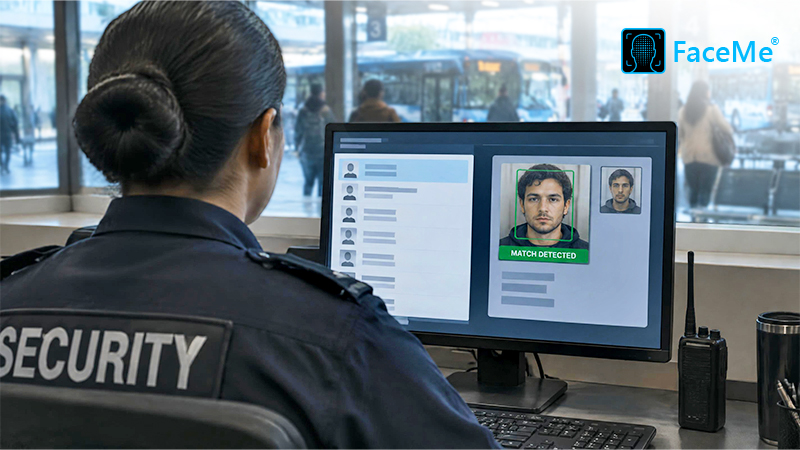
A regional transit agency in Ohio needed to identify known security threats before they entered stations or boarded vehicles, across a network of stations, transit centers, and buses. FaceMe® Security delivers real-time watchlist detection that works with the agency's existing surveillance infrastructure, alerting security personnel the moment a match is found.
FaceMe Security integrates with the agency's existing Genetec Security Center platform, so recognition alerts flow into the security workflow already in place, without replacing cameras or adding new infrastructure.
Assaults on transit workers have become a growing national concern. Major assaults tracked through the Federal Transit Administration's National Transit Database rose from 200 in 2014 to 675 in 2024, a 237.5% increase over the decade.1 Bus operators bear the brunt of it: they account for 63% of transit worker assaults across the U.S. and Canada, and the U.S. alone accounts for more than a third of the assaults researchers tracked worldwide.2
For a transit agency, the risk isn't confined to one building. A known threat might first appear at a station entrance, pass through a transit center, then board a bus, and a team watching fixed monitors can't always connect those moments fast enough to act before the person reaches a platform or a vehicle.
The agency needed a way to:
• Detect watchlisted individuals before they enter stations or board buses.
• Monitor stations, transit centers, and vehicles from a centralized security operation.
• Notify security personnel and vehicle operators immediately when a match is detected.
• Extend facial recognition from fixed infrastructure to onboard vehicles.
• Scale across hundreds of cameras without adding operational burden.
FaceMe Security continuously analyzes live video from station entrances, platforms, and onboard cameras, comparing faces against the agency's watchlist in real time. When a match is found, security personnel receive an immediate alert with the individual's image and camera location, so they can respond quickly and with full context.
Those alerts flow directly into the Genetec Security Center workflow security personnel already use. For onboard vehicles, FaceMe Security runs directly on supported AXIS cameras through the AXIS Camera Application Platform (ACAP), extending watchlist detection from stations to buses without new infrastructure or dependence on a constant network connection.
Because the platform works with the cameras already in place, the agency can extend watchlist detection to additional stations, transit centers, or vehicles as the network grows, without redesigning its security operations each time.
FaceMe Security does not replace the team monitoring the network or make decisions for them. It adds a layer of real-time awareness across every connected camera at once, most valuable when a small team is watching dozens of stations and vehicles at the same time. Across a network of more than 400 cameras, that awareness doesn't come at the cost of speed: recognition runs in real time on every feed at once, without the lag that scaling to a large camera network can otherwise introduce.
Rather than depending on an operator to recognize a face from memory or reviewing footage after an incident, FaceMe Security helps the team detect watchlisted individuals sooner and respond with more time to act.
Facial recognition used across a public transit network requires clear policies and oversight, since who appears on a watchlist, which stations are monitored, and how alerts are handled affect riders and employees system-wide.
The agency remains responsible for determining:
• Who is added to the watchlist and why.
• How long watchlist records and alerts are retained.
• Who can access facial data and alerts.
• How matches are reviewed and acted on in the field.
Role-based permissions and activity logs support that oversight.
Public comfort with this kind of monitoring depends on how it's used. FaceMe Security supports conservative deployments by design: unmatched faces can be set to anonymize automatically on a configured retention schedule, and privacy zones let the agency mask parts of a camera's view that fall outside a monitored entrance or platform, so a station camera captures no more of the scene than security requires.
Because FaceMe Security runs within the agency's own security infrastructure, alongside its existing Genetec Security Center platform, rather than through an external cloud service, the agency can apply that same governance without changing how it already stores and protects security data.
FaceMe Security gives the agency a practical way to spot known threats across its network before they escalate, using the cameras and security platform already in place.
• Watchlisted individuals are identified before they access transit services.
• Security personnel and vehicle operators are alerted immediately when a match is detected.
• Facial recognition extends from stations to onboard vehicles.
• The system scales to hundreds of cameras as the network grows.
Whether the network spans a handful of stations or a citywide fleet, FaceMe Security helps the agency get more value from the surveillance infrastructure it already has, while keeping riders and employees safer.
¹ Federal Transit Administration, National Transit Database, major transit worker assault data, FY2014 to FY2024 (2025 update).
² Mineta Transportation Institute, “A National-Level Hazard: Growing Assaults on Transit Staff” (May 2026).
 Book a Demo