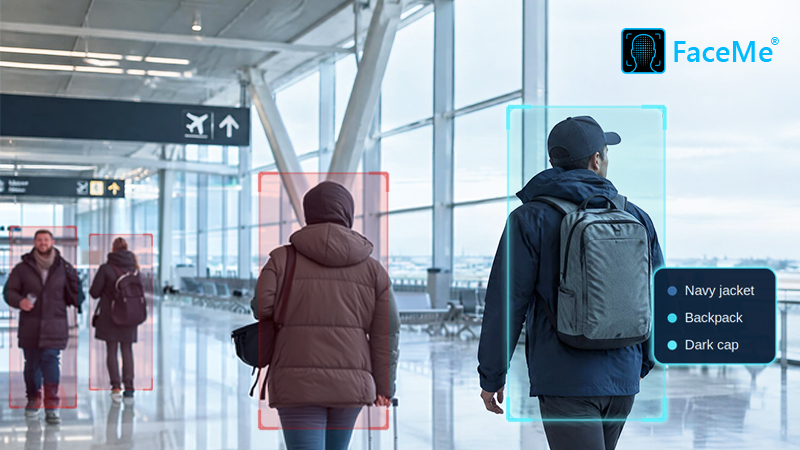
Appearance-based search lets a security team find a specific person using clothing, visible attributes, and a physical description, instead of a name or photo. A regional airport in the U.S. needed exactly that: a faster way to locate individuals connected to potential security concerns, often starting with nothing more than what someone looked like. Unlike major hubs with extensive screening operations, regional airports often have limited security personnel and lighter checkpoint procedures, so passengers, employees, and other airport staff play an important role in flagging suspicious behavior, unattended luggage, or other concerns before security gets involved.
FaceMe® Security's People Tracker recognizes visible attributes, clothing type and color, approximate age and gender, and accessories such as a hat or bag, for everyone captured on camera, and builds a searchable, timestamped record of it in real time. Security personnel search that record instead of combing through archived footage, and once a match is confirmed, the timestamp makes it simple to pull up the exact moment on video. The solution integrates with the airport's existing Genetec Security Center platform and uses cameras already installed throughout the terminals, eliminating the need for additional hardware.
Security concerns at regional airports do not always begin at a formal screening checkpoint. An airport employee notices unusual behavior, a passenger reports a concerning interaction, or someone discovers a piece of unattended luggage. In many cases, the only available information is a description of the person involved.
Airport security personnel must then determine whether the individual is still in the terminal, where they were last seen, and whether they're connected to the reported concern. Searching for that person manually can require reviewing footage from numerous cameras, one at a time, a process that costs a lean security team valuable time and can still come up empty.
The challenge is becoming more significant as passenger traffic grows. The Transportation Security Administration screened a record 904 million passengers at U.S. checkpoints in 2024 and intercepted 6,678 firearms.1
The airport needed a way to:
• Search for a specific person using a physical description rather than a name or facial image.
• Narrow results using clothing, color, and other visible attributes.
• Get a location lead on the person within minutes, not hours.
• Support investigations involving unattended luggage or reported suspicious behavior.
People Tracker runs continuously against the airport's live camera streams, recognizing clothing type and color, approximate age and gender, and accessories such as a hat or bag for everyone it sees, and storing that attribute data, timestamped, in a searchable database as it happens. It relies on Person Re-Identification and Person Attribute Recognition technology, so a clear view of the individual's face isn't required.
When airport personnel receive a report, they enter the available appearance details and search that database, not an archived video file. The system returns matching records, each tied to a specific camera and timestamp, and personnel review those results to confirm which ones are actually the person they're looking for.
That gives personnel a concrete starting point instead of reviewing hours of footage frame by frame. Once a match is confirmed, the timestamp makes it simple to pull up the corresponding video and verify it, then direct available personnel to that location.
This capability is particularly useful when:
• Security personnel need to follow up with someone who has moved away from a checkpoint or inspection area.
• Unattended luggage is discovered and the team needs to identify or locate the person who left it.
• The only available information is a description of the person's clothing or belongings.
Because People Tracker works with the airport's existing Genetec Security Center environment, the search capability extends across connected terminal cameras without requiring a separate surveillance system. New cameras and terminal areas can be incorporated as the airport expands.
Appearance-based search across an airport's camera network requires clear governance. The tool itself doesn't replace human observation or judgment; personnel still decide when to search, review the results, and confirm a match before acting on it.
Policies should define:
• Who can search for a person, and under what circumstances.
• Who can access the system and its results, and how long records are retained.
• How matches are verified before action is taken, and how searches are documented.
Access to the tool is controlled through role-based permissions, and it's designed to protect privacy by default: People Tracker can conduct a search using appearance attributes without creating a facial profile of every traveler captured on camera. Configurable retention policies help ensure that data is removed according to the airport's requirements, while privacy zones can mask areas of a camera's view that are not relevant to security monitoring.
FaceMe Security is designed to run on infrastructure the airport controls, so surveillance data can stay within the airport's existing storage and security policies rather than moving to a separate external service.
Since deploying People Tracker in January 2026, the airport has had a practical way to locate a person of interest across its existing camera network, even when the search begins with only a general description.
• Searches that previously required 10 to 15 minutes of manual review, or produced no useful result, can now return a lead within minutes.
• Personnel can search using clothing, color, age, gender, and accessories like hats or bags, without requiring a clear facial image.
• A single search can cover connected cameras throughout the airport.
• Security teams can respond more quickly to reports involving suspicious behavior or unattended luggage.
For a regional airport with limited security resources, that's the difference between searching broadly and heading straight to where the person actually was.
¹ Transportation Security Administration, calendar year 2024 passenger-screening and firearms-interception data (January 2025).
 Book a Demo