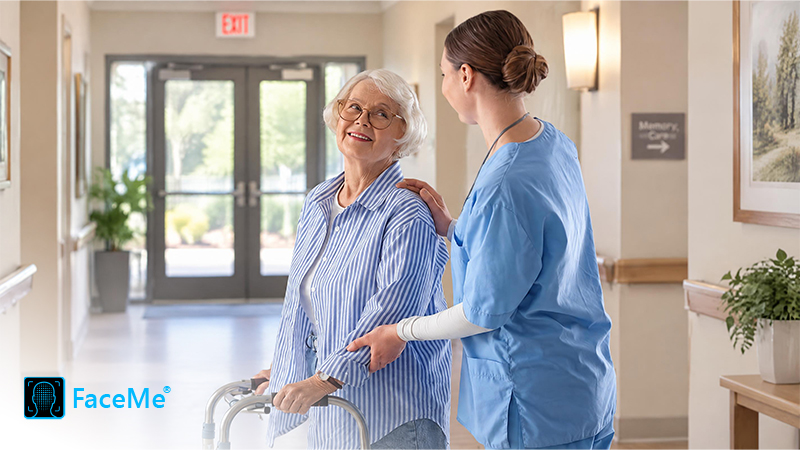
A memory care facility in Ohio with more than 95 beds needed a fast, reliable way to know when a resident who requires an escort was attempting to leave unaccompanied. FaceMe® Security recognizes those residents automatically at the facility's main hallway exit and alerts the front desk the instant one of them approaches without an escort, giving staff enough time to intervene.
The system runs on a single camera and triggers an indicator light at the front desk, instead of requiring a video management system, extra hardware, or any change to how the facility already manages resident care.
Memory care isn't a small niche within senior living, it's most of it. Seventy percent of assisted living residents nationwide have some degree of memory impairment, according to the American Health Care Association and National Center for Assisted Living.1 For a facility serving that population, an unescorted exit isn't a rare exception. It's a risk built into daily operations, one the senior-living industry calls elopement.
It's also common. Six in 10 people living with dementia will wander at least once, and many do so repeatedly, according to the Alzheimer's Association.2 The stakes rise fast from there: a person with dementia who isn't found within 24 hours has only about a 50% chance of survival, and search efforts in the meantime can run roughly $1,500 an hour, according to research compiled by the National Council of Certified Dementia Practitioners.3
Before FaceMe Security, catching an unescorted exit depended entirely on a receptionist happening to look at the right moment, on a busy shift, during a shift change, or when a new hire hadn't yet learned every resident by sight.
The facility needed a way to:
• Recognize residents who need an escort before they reach the exit.
• Alert staff immediately when one of those residents approaches alone.
• Avoid stopping or restricting residents who don't need supervision.
• Work with a single camera, without new infrastructure.
• Reduce reliance on staff memorizing every resident's face.
A single camera facing the facility's main exit compares every face against a list of residents identified as needing an escort to leave safely. When one of them is spotted heading for the exit, an indicator light at the front desk turns red, so the receptionist can step in and confirm an escort before the resident leaves. The light stays green for everyone else, residents, staff, and visitors alike.
That takes the burden off the receptionist, who no longer must personally track who's approaching or split attention between the hallway and their other responsibilities. FaceMe Security handles the recognition itself and only calls for attention when it's actually needed.
The receptionist still decides what happens once an alert is triggered. What changes is coverage: awareness at the one exit that matters most, at any hour, including overnight and during shift changes, when a single staff member has the least room to look away.
New staff are covered from day one, too. They don't need to have memorized a single face yet for the system to recognize a resident who needs an escort.
Recognizing residents for their own safety only works with clear rules behind it, since who's placed on the escort list, how that decision gets made, and who can see an alert all affect residents and their families.
The facility still decides:
• Who is placed on the escort-required list, and why.
• How long alerts and related footage are retained.
• Who can access that footage and the resident list.
• How staff respond when the light turns red.
Access to the resident list and its alerts is controlled through role-based permissions.
The same conservative approach carries into how footage is handled: unmatched faces can be set to anonymize automatically on a configured retention schedule, and privacy zones let the facility mask any part of a camera's view beyond the exit itself.
FaceMe Security is designed to run on-site rather than through an external cloud service, so the facility applies that same governance without changing how it already protects resident information.
FaceMe Security gives the facility a practical way to catch an unescorted exit before it becomes a search, without asking staff to keep their eyes on the hallway through every minute of every shift.
• A resident who needs an escort is flagged before reaching the exit, not after.
• Staff are alerted immediately, without relying on memory or constant observation.
• Other residents and visitors move freely, without unnecessary stops.
• No video management system or extra hardware was needed to set it up.
A busy afternoon and the middle of an overnight shift look the same to the system: it keeps the front desk focused on what matters most, right when it matters.
¹ American Health Care Association and National Center for Assisted Living (AHCA/NCAL), assisted living resident memory-impairment data, as compiled by ConsumerAffairs (2026).
² Alzheimer's Association, “Wandering,” caregiving safety guidance (accessed 2026).
³ National Council of Certified Dementia Practitioners, “Wandering and Elopement” white paper (March 2024).
 Book a Demo