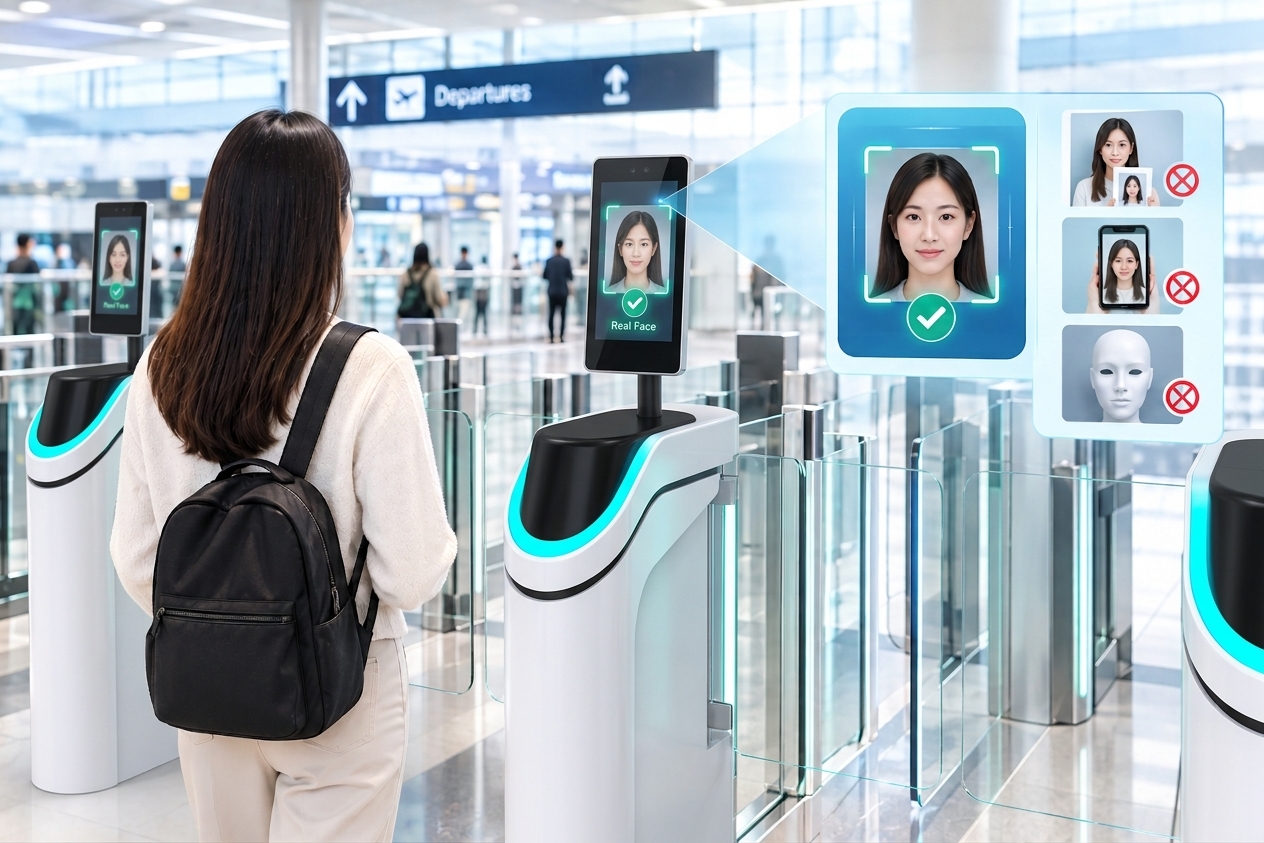
Airports around the world are moving to smart border management, and eGates (automated border control, or ABC systems) are becoming a primary way to process arriving and departing travelers. MiTAC Information Technology has added CyberLink FaceMe liveness detection to its eGate system. FaceMe uses AI models trained for the specific cameras in the gates to check whether a live person is in front of the camera. This provides stronger protection against spoofing with photos, videos, and 3D masks. The liveness check fits into the existing eGate process and works alongside the current passport check, face matching, and gate control. This strengthens security without disrupting the clearance process.
Travelers want faster, easier clearance, so airports keep expanding automated border checks. In Taiwan, as of the end of June 2026, more than 80% of Taiwanese citizens used eGates when entering or leaving the country [1]. Singapore's Changi Airport now offers fully passport-free automated clearance for Singapore residents entering and leaving the country and for foreign visitors departing [2]. In high-traffic airports, eGates have become a core part of the border clearance process.
As eGates become the main way travelers are checked, preventing identity fraud matters more. Face recognition confirms that the traveler matches the identity shown on the passport. Liveness detection goes a step further by verifying that a real person is in front of the camera, which helps block spoofing with printed photos, phone videos, and 3D masks. In a self-service setting, the system must verify each traveler quickly, and new security measures can't slow the line down. The core challenge for airport eGates is to stop spoofing without hurting clearance speed.
The eGate system adds FaceMe liveness detection to its existing passport check and face matching. Together they form three verification steps: document check, liveness check, and identity match. This keeps clearance both secure and easy. As travelers follow the on-screen guidance, FaceMe checks whether a real person is in front of the camera, guarding against photos, video replays, and 3D masks. The existing system handles the passport check and face matching to confirm that the traveler matches the document. FaceMe runs liveness detection on the device itself, so the check fits directly into the current clearance flow.
To serve travelers of different heights, the FaceMe team worked with MiTAC to tune the liveness detection range to the eGate's camera setup. The system supports travelers from 120 to 200 cm tall [3]. Travelers simply follow the usual guidance and complete the liveness check without any extra steps, so the experience stays both secure and convenient.
With FaceMe liveness detection, the eGate system provides stronger protection against identity fraud without changing the existing verification process. Because the system was integrated and tuned to the camera setup, travelers of different heights can complete the liveness check naturally, with no added steps.
Total clearance time is under 10 seconds [7], with FaceMe liveness detection included. Travelers get a fast, secure, and convenient smart clearance experience.
 Book a Demo