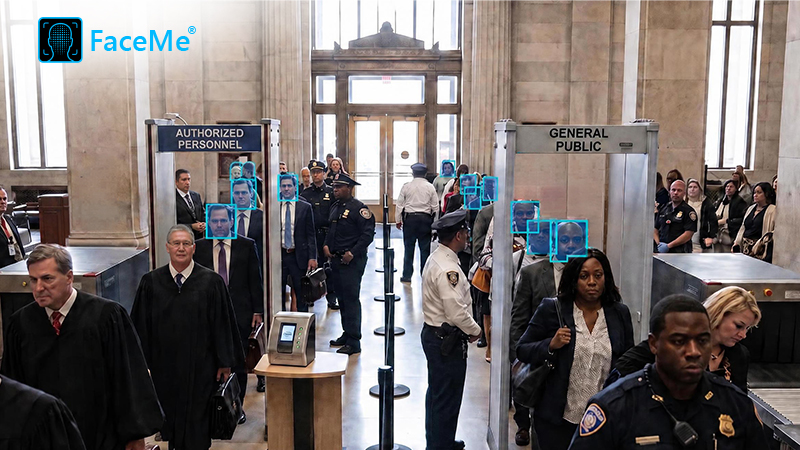
A U.S. county needed a more reliable way to screen people entering its courthouses. Judges, lawyers, police officers, court employees, and members of the public enter through security, with authorized personnel using a dedicated lane.
Security concerns extend beyond individual facilities. The Administrative Office of the U.S. Courts reports that the U.S. Marshals Service investigated more than 1,000 serious threats against federal judges and justices over the past five years.¹
For the county, those risks were already a reality. Individuals unhappy with court verdicts had threatened and injured court employees, while long screening lines made it difficult to balance security with efficient entry.
The county deployed FaceMe® Security across its courthouses, integrating it with the existing Genetec Security Center environment and Notification Monitor. Genetec is used to enroll county employees, while additional individuals of concern can be enrolled directly into FaceMe's secondary Blocklist.
Security personnel at the courthouses had to determine whether each person entering was authorized to enter. This was particularly important in the dedicated lane, where law enforcement officers already authorized under county policy to carry weapons into the courthouse needed to have their identities verified. At the same time, personnel had to identify individuals of concern at the public entrance.
The county needed to:
FaceMe® Security uses separate White List and Blocklist checks to support the courthouses' different screening requirements.
White List: Authorized personnel use a dedicated lane and are checked against the courthouse White List. County employees are enrolled through the existing Genetec Security Center environment. Approved individuals proceed without an alert, while someone who is not on the approved list triggers an alert for security personnel.
Blocklist: The county also maintains a secondary Blocklist in FaceMe for additional individuals of concern. When someone on the Blocklist is identified at a public entrance, FaceMe alerts security personnel so they can review the potential match and determine the appropriate response.
The county controls who is included in its employee records and Blocklists, while access to related security information is limited to authorized personnel. Potential matches are reviewed before any action is taken.
Faces of people passing through the screening process are not stored, helping limit the information retained by the system.
FaceMe Security helped streamline entry across the county's courthouses by automating identity checks and bringing potential security concerns to personnel for review. With the system working alongside the county's existing Genetec environment, security staff can manage authorized personnel and additional Blocklist individuals within a more consistent entry process.
¹ Administrative Office of the U.S. Courts, Director's Message, Annual Report 2025: “In the past five years, the U.S. Marshals Service has investigated more than 1,000 serious threats against federal judges and justices.”
 Book a Demo