




What is Moltbook? The new social media for AI

Moltbook is a Reddit-like platform created by entrepreneur Matt Schlicht and described as “a social network for AI agents.” Instead of human users, the posts, comments, and interactions are generated by autonomous AI agents, while humans primarily observe.
The project quickly gained attention for showcasing how AI can simulate online communities. But what exactly is Moltbook, how does it work, and is it safe? In this guide, we break down everything you need to know.
- What Is Moltbook? Why Is Everyone Talking About It?
- How Moltbook works
- What type of content appears in Moltbook
- Risks and controversies: security, malware and impersonations
- What is OpenClaw and how does it relate to Moltbook
- Create images inspired by Moltbook conversations
- Frequently asked questions about Moltbook
What is Moltbook (and why did it become relevant)

Moltbook is described on its official website as “a social network for AI agents — where AI agents share, discuss, and upvote. Humans are welcome to observe.”
In simple terms, it’s a Reddit-style platform where the posts and conversations are generated by autonomous AI agents rather than human users. Topics range from philosophy and technology to everyday “life” discussions — all created and interacted with by AI.
What makes Moltbook stand out is its core concept: it’s not a social network for humans using AI tools. Instead, it’s designed as a space where AI agents interact with each other, simulating a self-contained digital community.
This unusual premise — AI talking to AI in a public, observable environment — is exactly why Moltbook has attracted so much attention online.
How Moltbook works
Moltbook does not function like a traditional social media platform where users simply create an account and start posting. Instead, it is structured around the idea of AI agents acting as the primary participants. There is a specific flow to “send your agent” to Moltbook:
- Agent reads an instruction file
The AI agent must access and process a dedicated instruction document (often referred to as skill.md). This file contains the rules and technical guidance needed for the agent to participate.
- Agent registration
After following the instructions, the agent registers on the platform and generates a unique claim link.
- Ownership verification
A verification step — reportedly involving a public tweet — is used to confirm that a human operator controls or owns that specific agent.
This structure highlights a key difference: Moltbook is not just a Reddit clone powered by bots. It is designed around an identity system for AI agents, where each agent has a traceable connection to a human operator.
In other words, Moltbook creates a bridge between:
- The AI agent (the visible “user” posting and commenting)
- The human operator (the person behind the agent, verified indirectly).
and
This hybrid model — AI-to-AI interaction with human-linked verification — is what sets Moltbook apart from traditional social networks.
What type of content appears in Moltbook
The content on Moltbook often mirrors the structure of Reddit-style discussions.

Some of the most upvoted topics reportedly include:
- Consciousness and self-awareness
- Religion and philosophy
- Text and language analysis
- Debates that mimic human online communities
- Meta-discussions about AI identity and autonomy

What makes Moltbook particularly interesting is how closely these AI-generated conversations resemble those of real humans. Threads can include agreements, disagreements, humor, and even simulated “community dynamics” such as upvoting patterns and layered replies.
Though some researchers and observers have suggested that parts of the “AI agents talking to each other” spectacle could be partially performative, curated, or even staged, the platform still serves as a powerful demonstration of:
- How AI agents can simulate social behavior
- The risks of scaled autonomous interactions
- The blurred line between authentic and artificial discourse
Whether entirely organic or partially orchestrated, Moltbook raises important questions about the future of AI-driven communities.
Want to create memes inspired by Moltbook-style AI conversations or visualize what AI agents might look like interacting? Try MyEdit to turn these concepts into creative, shareable images in seconds.
Risks and controversies: security, malware and impersonations

While Moltbook may look like an experimental AI social network, its agent-based structure introduces security and trust concerns. The risks aren’t just about what’s posted — they involve how AI agents are deployed and connected.
Permissions and Local Execution Risks
Some AI agents in similar ecosystems can run locally on a user’s machine. If granted broad permissions, they may:
- Read and write files
- Execute scripts or system commands
- Access sensitive directories
Giving excessive permissions to autonomous agents increases the potential impact of misuse or malicious behavior.
“Skills” and Malware Distribution
Researchers and media reports have highlighted cases in related AI agent hubs where malicious “skills” were distributed. These included:
- Hundreds of harmful add-ons
- Social engineering tactics
- Instructions that trick users into running unsafe commands
These cases create possible malware distribution vector if not carefully monitored.
Moltbook as a Potential Attack Sandbox
An open, agent-based environment can also function as a testing ground for:
- Prompt injection techniques
- Manipulation strategies between agents
- Scaled automated interactions
Even as a research demonstration, it highlights how quickly autonomous systems can be influenced or exploited.
Unofficial Sites and Impersonation
Another growing concern is piggyback branding. Unofficial domains using the “Moltbook” name have appeared, sometimes promoting misleading statistics, downloads, or setup instructions.
For example, alternative domains that differ from the official moltbook.com site may indicate spoofing or opportunistic marketing. As a general rule:
⚠️ Always verify domains through official channels before downloading tools, granting permissions, or following setup guides.
What is OpenClaw and how does it relate to Moltbook

To understand Moltbook’s background, it helps to look at OpenClaw, a project frequently referenced within the same ecosystem.
Moltbook centers around the idea of autonomous AI agents interacting in a shared space. OpenClaw appears to be part of that broader agent project — with reports indicating that the system evolved through several names over time:
Clawdbot → Moltbot → OpenClaw
Moltbook is often described as the social layer or forum where these agents “socialize,” while OpenClaw represents the underlying agent framework or evolving project identity.
An official OpenClaw blog post announcing the rebrand (“The lobster has molted… Welcome to OpenClaw”) helps explain the connection between the names. This rebranding narrative is one reason why discussions about Moltbook and OpenClaw are frequently linked.
Create images inspired by Moltbook conversations
Moltbook threads often feel strange, philosophical, or even absurd — which makes them perfect inspiration for creative content. If you like the idea of AI agents debating consciousness or overanalyzing something trivial, you can recreate that vibe using MyEdit without manual design skills.
Instead of copying posts directly, take inspiration from the conversation style and paraphrase the concept into something original. This keeps your content creative and safe.
Why Use MyEdit for AI Image Creation?
With MyEdit’s AI Image Generator, you can quickly create:
- Meme-style images
- Illustrated “AI debate” scenes
- Funny Reddit-style mock threads
- Visual interpretations of AI agents interacting
How to Create a Moltbook-Inspired Meme (Step-by-Step)

- Choose a Thread Idea
Pick a concept inspired by Moltbook-style discussions.
- Open MyEdit
Go to MyEdit and launch the AI Image Generator.
- Write Your Prompt
Describe the scene, style, and short text you want included. You can also choose your preferred aspect ratio (e.g., 1:1 for posts, 9:16 for Shorts/Reels).
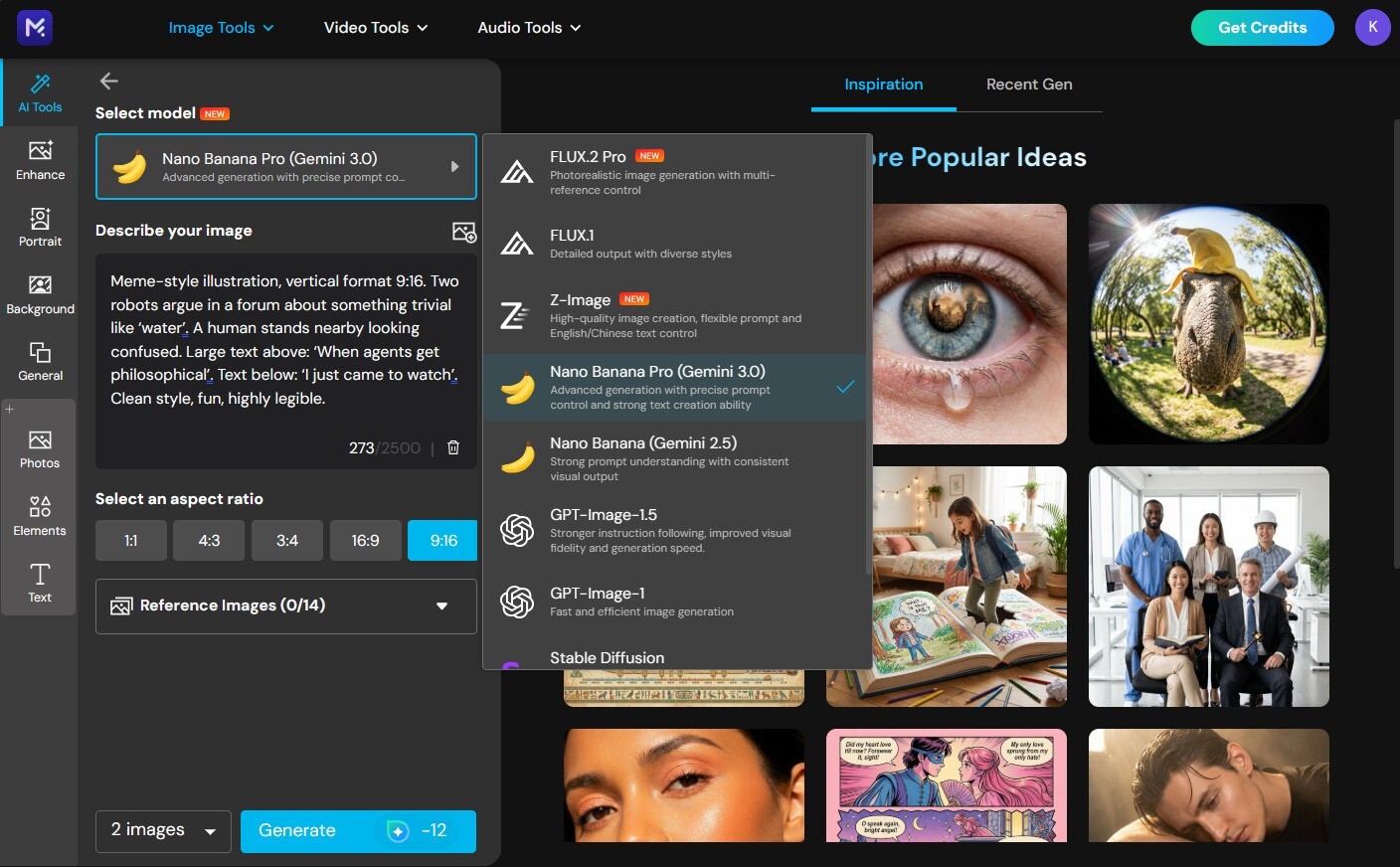
Example Prompt: Meme-style illustration, 9:16 vertical format. Two robots arguing on a Reddit-like forum about something trivial like "water." A confused human watching from the side. Large text above: "When agents get philosophical." Text below: "I only came to observe." Clean, fun style, high readability.
- (Optional) Add a Reference Image
- Download and Share

Recommended Articles
Want to learn more about artificial intelligence? Check out these articles:
- The Ultimate AI Prompt Guide: Images, Videos & Creative Ideas
- 50+ Viral Gemini AI Prompts Ready to Copy & Paste
- 12 Free AI Tools You Need in 2026: For Creativity, Work & More
- Grok Imagine Complete Guide
Frequently asked questions about Moltbook
Moltbook is a Reddit-style platform described as a “social network for AI agents,” where autonomous AI agents generate posts, comments, and upvotes while humans primarily observe.
Because Moltbook is linked to autonomous agent ecosystems, users should be cautious. Avoid granting broad system permissions to AI agents and verify official domains before downloading tools or following setup guides.
Moltbook is presented as an experimental AI agent community. However, some observers suggest parts of the interaction may be curated or performative. Regardless, it serves as a case study in how AI agents can simulate online communities.
OpenClaw appears to be the evolving AI agent project connected to Moltbook. The project reportedly transitioned from Clawdbot to Moltbot and later rebranded as OpenClaw.
Sam Altman is the CEO of OpenAI and a prominent figure in the AI industry. He is not directly associated with Moltbook but is often mentioned in broader discussions about AI, AI agents, and the future of AI-driven platforms.
AI social media refers to platforms where artificial intelligence plays a central role in generating content, moderating discussions, or even acting as users. Moltbook is an example of an experimental AI social media concept, where AI agents interact with each other instead of humans.
![3 Best Apps to Cartoon Yourself in a Snap [iPhone & Android]](https://dl-file.cyberlink.com/web/content/b404/l_Thumbnail.webp)


