Sustainability Governance Framework
To realize our vision of sustainable operations and strengthen our ESG governance, CyberLink's Board of Directors approved the Charter of the Sustainable Development Committee on October 29, 2025, and formally established the Sustainable Development Committee. Reporting directly to the Board of Directors, the Committee serves as the Company's highest supervisory body for sustainability governance.
The Sustainable Development Committee consists of one director and two senior executives, with the Chairperson serving as the Committee Chair and the President as the Vice Chair. The Committee is responsible for tracking domestic and international sustainability trends, formulating sustainability strategies and policies, and overseeing the Company's sustainability-related affairs.
To carry out its duties effectively, the Committee has set up the Sustainability Development Working Groups. The Committee Chair appoints members from department heads, including managers with expertise in finance and accounting, legal affairs, information technology, sustainability, corporate governance, and human resources, as well as the head of the Perfect CyberLink Education Foundation. There are four Working Groups: the Environmental Sustainability Group, the Social Contribution Group, the Employee Care Group, and the Corporate Governance Group. Through cross-departmental collaboration, they embed sustainability goals into daily operations and put corporate social responsibility into practice.
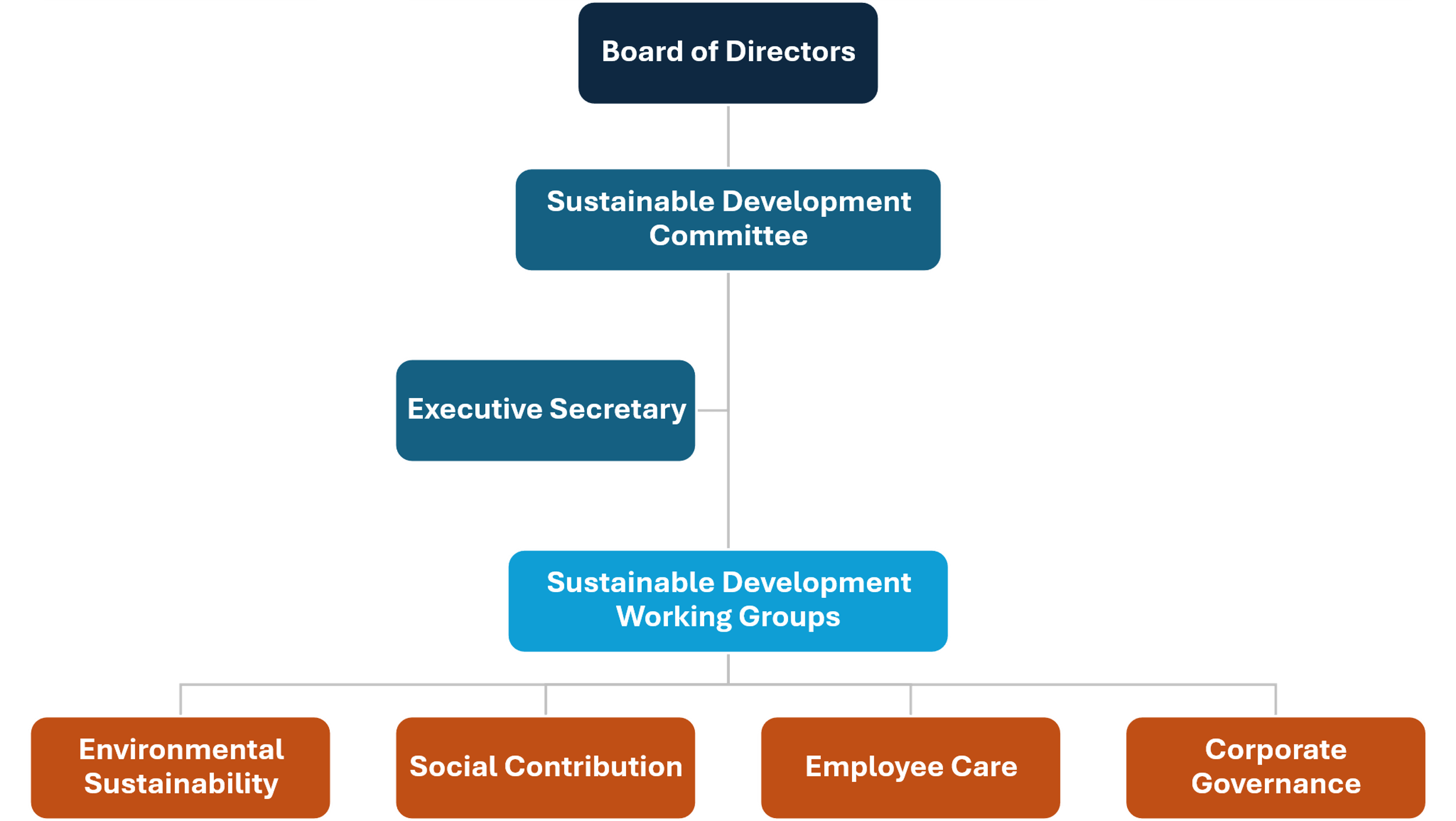
After gathering stakeholder feedback and assessing the Company's sustainability needs, the Sustainable Development Working Groups draft related policies, systems, and action plans, which are submitted to the Sustainable Development Committee for review. Once approved by the Committee, the Working Groups are responsible for promoting and executing each sustainability project, and regularly report implementation status and results to the Board of Directors.
Each sustainability project is planned, executed, reviewed, and continuously improved under the PDCA (Plan-Do-Check-Act) management cycle. Sustainability strategies are systematically integrated into daily operations, and cross-departmental coordination and resource integration ensure that these strategies are effectively implemented and continuously refined.
In 2025, the Sustainable Development Working Groups held multiple cross-departmental meetings and reported progress and results to the Board of Directors on a regular basis, on February 27, March 26, April 29, July 30, and October 29, 2025.
Materiality Assessment and Topic Management
CyberLink regularly conducts materiality analysis, currently following the GRI Standards as the framework. We have developed an impact-oriented approach to materiality assessment, enabling the identification of key sustainability topics.
In addition, CyberLink integrates material topics with its corporate risk management, identifying sustainability topics that may pose potential risks from the perspective of organizational resilience, and incorporating them into the sustainability management process.
Materiality analysis not only serves as the basis for regular disclosures but also provides critical input for our long-term sustainability goals and strategies. Our specific steps for identifying material topics include:
| 1. Collection |
|
Sustainability topics highly relevant to CyberLink are identified through the following channels:
|
| 2. Identification |
|
All topics are assessed for materiality using the following methods:
|
| 3. Confirmation |
|
Based on the materiality identification results, the Sustainable Development Committee confirms the classification of topics:
|
| 4. Response and Tracking |
|
Material and secondary topics are tracked and addressed as follows:
|
In 2025, CyberLink classified and analyzed 17 sustainability topics, resulting in a materiality matrix. The assessment identified 8 material topics, 3 secondary topics, and 6 low-materiality topics.
- Business Performance and Operations
- Human Rights, Diversity, and Inclusion
- Information Security and Data Privacy Protection
- Customer Relationship Management
- Employee Health and Occupational Safety
- Innovation and R&D
- Corporate Social Responsibility and Community Engagement
- Legal Compliance
- Talent Recruitment, Retention, and Development
- Risk Management
- Integrity and Business Ethics
- Energy and Resource Management
- Waste Management
- Sustainable Products
- Climate Change Response
- Supply Chain Management and Procurement Policy
- Corporate Governance
For material and secondary topics, the Sustainable Development Committee and the Sustainability Working Groups have established corresponding risk management policies and response strategies, with related management information regularly disclosed through our sustainability reports, annual reports, and other channels.
Looking ahead, we will continue to review and update material topics and their associated risk response measures to ensure strong alignment between sustainability strategies and enterprise risk management, thereby enhancing overall resilience and building stakeholder trust.
Sustainability Goals Management
CyberLink establishes short-, medium-, and long-term sustainability development goals through a comprehensive evaluation of business operations, industry trends, and materiality assessment results. These goals are regularly reported and discussed at the Board of Directors meetings to ensure continuous progress in sustainability development.
| Topic | Short-term Goal | Medium-term Goal | Long-term Goal | |
| 2026 | 2027 to 2029 | 2030 | ||
| Corporate Governance & Economic | Corporate Governance |
|
|
|
| Information Security |
|
|
|
|
| Integrity and Business Ethics |
|
|
|
|
| Environmental | Green Sustainability |
|
|
|
| Social | Compensation & Benefits |
|
|
|
| Talent Development |
|
|
|
|
We conduct an annual review of the achievement of our goals and implement improvement actions for any unmet targets. The table below presents the 2025 goals and their achievement status:
| Topic | 2025 Goal | Result | |
| Corporate Governance & Economic | Corporate Governance |
|
Total score improved over the previous year, but the ranking tier remained unchanged; target not met |
| Information Security |
|
Achieved | |
| Business Ethics and Integrity |
|
Achieved | |
| Environmental | Green Sustainability |
|
Water use intensity decreased by 1.82% (target not met due to increased shared water allocation from new companies in the office building). Other goals achieved |
|
Achieved | ||
| Social | Compensation & Benefits |
|
Achieved |
| Talent Development |
|
Achieved | |
